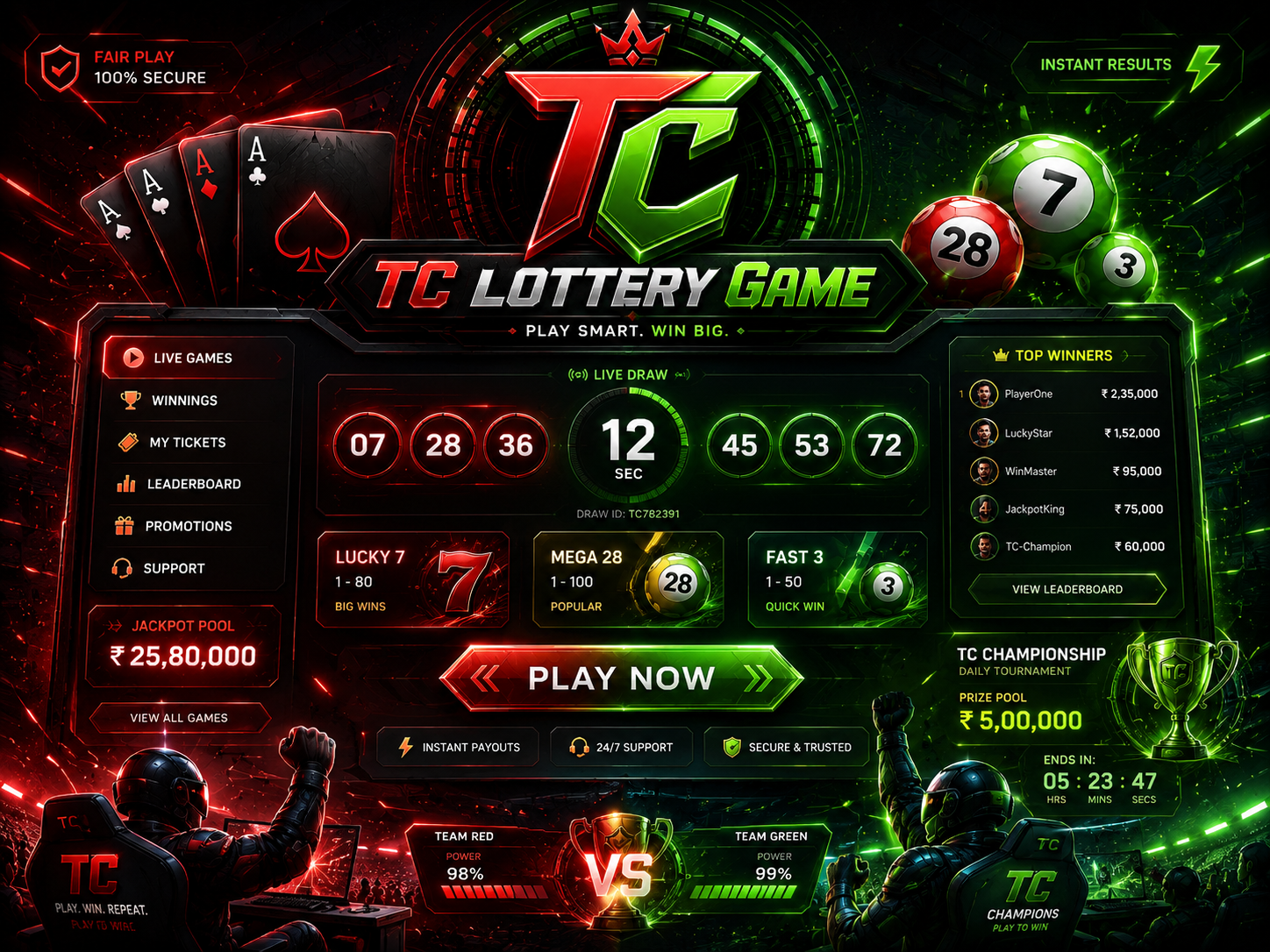
A draw screen can show current balls, earlier rows, coloured panels, and a changing clock. That information may look as though it contains a pattern waiting to be discovered. A past number may appear repeatedly, while another number may seem absent. The important boundary is that a historical count describes what has already appeared. It does not decide what a later random draw must show.
This distinction matters when reading a TC Lottery Game screen in India. The page presents a draw control view for adults, with attention on the draw label, timer, number row, red and green panels, prompt text, and exit route. It does not operate paid games, promise a result, collect payment, or turn a past display into a forecast.
What a frequency count can and cannot say
A frequency count is a record of how often a value appeared within a selected group of past displays. It can help describe the visible history if the reader knows which rows belong together and which rows are only sample art, decoration, or a different state. It cannot show that a value is due, safe, favoured, or more likely to appear next.
A past result does not become more likely merely because it has been absent. In the same way, a repeated result does not become less likely merely because it has appeared several times. These are common interpretations of a board, but they are not conclusions supported by frequency alone.
Suppose a reader labels two abstract values as Number A and Number B. Number A appears several times in a clearly identified historical row, while Number B appears less often. If the next draw is independent of that earlier display, the count does not give Number A a special claim and does not give Number B a correction advantage. The count remains a description of the past row.
Start with the row, not the apparent pattern
The first check is not arithmetic. It is identification. Read the draw label and the nearby wording before counting anything. A number row may be current, past, sample, or part of a graphic background. Combining those categories can create a frequency result that looks precise but has no clear meaning.
- Read the draw label. Confirm which draw name or room title the row is associated with. If the label is unclear, pause the count.
- Check the timer state. Notice whether the clock is active, closing, paused, or displaying a past state. Timing helps place the screen in context, but it does not forecast a value.
- Separate current and historical rows. Do not mix a current number row with earlier rows, sample graphics, or decorative panels.
- Record only visible information. If a ball or label is covered by a prompt, mark it as unclear rather than filling the gap from memory.
- Compare the colour panels with their labels. Red and green areas may represent screen states, options, or groups. Colour alone does not prove a number pattern.
- Keep an exit route. Leave the screen when the label, timing, prompt, or personal judgement feels unclear.
This process prevents a visual impression from being mistaken for a statistical conclusion. It also avoids treating a bright panel or a repeated ball as a signal to hurry.
Why a short history can mislead
A small set of observations can look uneven even when no special force is acting on the draw. One value may cluster near the beginning of a row. Another may be missing from the visible section. Such variation is not, by itself, evidence of a trend or a correction waiting to happen.
The meaning of a frequency count also depends on how the reader selected the history. A count taken from one visible row is not automatically comparable with a count taken from several different screens. A paused display may be mistaken for a new draw. A sample panel may be included beside a live-looking ball. A number may be read twice if the row is copied without checking its title.
Even a carefully recorded history has a limited role. It can answer a descriptive question such as, “Which values were visible in this selected past set?” It cannot answer a predictive question such as, “Which value must appear next?” Those questions require different evidence, and a screen count does not supply the second type.
A practical separation between record and forecast
Use two separate notes if you need to inspect a screen. The first note can contain only confirmed display details: the draw label, the timer state, the identified row, and any visible values. The second note should state what remains unknown. Do not place a prediction beside the record as if it were another screen fact.
For a hypothetical review, a reader might write: “Number A was visible in the selected past row; Number B was also visible; the row title was clear; the current state was not confirmed.” That is a usable record. Writing “Number A is due next” changes the record into an unsupported claim.
The same rule applies to colour. A hypothetical red panel can be recorded as red if that is plainly visible. It cannot be treated as proof that a related value will appear. If the panel has no clear nearby label, its meaning should remain unresolved.
Do not treat prompts as probability evidence
Some app screens use payment-style, shield-style, or gift-style panels. A prompt may cover part of the board or change what the reader sees next. These visual elements are reasons to slow down, not evidence that a particular number has a stronger chance.
If a third-party app asks for money, identity details, or extra permissions, stop and review that service's own terms before continuing. This guide does not manage accounts, balances, or third-party app actions. No frequency note can confirm that a payment request is genuine, necessary, or connected to a draw result.
Adults should also avoid allowing urgency to replace verification. A closing clock may encourage a quick decision, but speed does not improve the information in a historical row. If the timer, prompt, or label is confusing, the sensible action is to pause or leave the screen.
Related reading for screen checks
For a broader look at treating the display as a control board rather than a prediction tool, read TC Lottery Game number balls and hot-cold limits. For a separate discussion of checking the relationship between screen timing and visible states, see TC Lottery Draw Gap Checks for Adult Readers.
Limits of this guide
No verified public result record was supplied for this review, so there is no result, issue reference, or date to report. Nothing here confirms a completed draw or identifies a next value. The method is limited to reading the information visible on a screen and separating confirmed display details from assumptions.
Historical frequency can be useful for describing a selected past row when its label and scope are clear. It cannot convert changing or random outcomes into a promise. The safest conclusion is modest: check the row, check the timing, note what is actually visible, and leave any future result unknown.
Responsible entertainment note: This article is for screen reading and risk awareness only. It does not provide betting advice, account service, payment handling, outcome prediction or any guaranteed result.